Showing posts with label Shakespeare. Show all posts

Monday, September 19, 2011

Questions on "King Lear" for September 26th


Why does Lear demand a public declaration of affection from his daughters before dividing his kingdom?

Why does Cordelia refuse to play along with her father's game?

When Gloucester attempts suicide, why does Edgar decline to reveal his true identity (Act IV, Scene Six)?

What is Lear's attraction to the "philosopher," Tom O'Bedlam? (Act III, Scene Four, pp. 175-177, Act III, Scene Six, pages 178-80)?

Why do Goneril and Regan end up in fatal competition for Edmund?

Does "King Lear" suggest that human sexuality is the root cause of all corruption?


Evaluative Questions

In Act III, Scene One, How does the storm in the open country mirror the king's emotional state?

What is the significance of the word "nothing" in the play (it appears in many places, cf. Act I, Scenes One and Two.)

What is the meaning of Edgar's lines:

Men must endure
Their going hence, even as their coming hither;
Ripeness is all


Is it possible to envisage an alternative, happy, ending to the play?

If no, is the ending the best one could hope for? Is Edgar going to be King? Will he be a better King than Lear?


Passages for Textual Analysis

A. Act I, Scene Two, pages 129-130, from Gloucester's speech beginning, "These late eclipses in the sun and moon ..." to Edmund's speech ending, "O, these eclipses do portend these divisions, Fa, sol, la, mi."

B. Compare the Fool's speeches,

1. Act I, Scene Four, pages 136-137 beginning, "That lord that counsell'd thee ..." to "All thy other titles thou has given away; that thou wast born with."

2. Act II, Scene Four, page 157 beginning, "Fathers that wear rags ..." to "daughters as thou canst tell in a year."

3. Act II, Scene Four, pages 157-58, beginning, "We'll set thee to school to an ant ..." to "Not 'i the stocks, fool."

4. Act III, Scene Two, page 168, beginning, "the cod-piece that will house ... " to "For there was never yet fair woman but she made mouths in a glass."

5. Act III, Scene Two, page 170 beginning, "He that has and a little tiny wit ..." to "This prophecy Merlin shall make; for I live before his time."

C. Act IV, Scene Six, pages 200-203 from Lear's speech beginning, "Ha, Goneril, with a white beard," to Lear's speech ending, "you shall get it by running, Sa, Sa, Sa, Sa.

D. Act V, Scene Three, pages 213-214, from Lear's speech beginning, "No, no, no, no! Come let's away to prison." to Lear's speech ending, "We'll see 'em starv'd first. Come."

Tuesday, April 20, 2010

Discussion Questions for "The Tempest"

What are Prospero's powers? Where do they come from? What do they accomplish in settling accounts between Prospero and Antonio/Sebastian/Alonso?

How will Prospero and the others get back to Milan? Will he be a better duke the second time?

What's the significance of the Ferdinand-Miranda partnership? Is it meant to be a model of political legitimacy?

Is Miranda portrayed as solely a possession to be passed from father to husband?

Why is the wedding masque (Act IV, sc. 1) cut short when Prospero remembers that Trinculo/Stephano/Caliban are after him?

What are the parallels between the main plot (politics on the Italian peninsula) and the subplot (i.e., what takes place on the island)?

Evaluate Prospero's fathering skills as evidenced by his relationships with (a) Miranda, (b) Ariel, and (c) Caliban.

How does Gonzalo fit his billing in the List of Characters as "an honest old Counsellor"?


Is this a "comedy" in the sense that it has a happy ending? What's left unsettled by the ending?

Friday, April 9, 2010

The Bard's Month

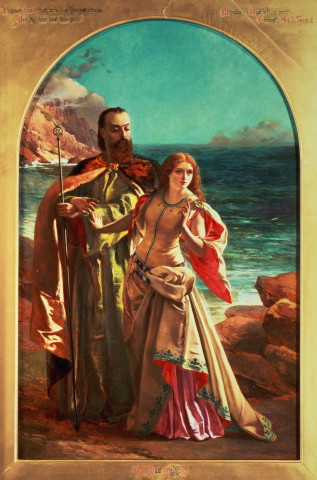
Left: Prospero and Miranda, by William May Egley, ca. 1850.

To mark the month of April, which is: (a) National Poetry Month ; (b) Shakepeare's birthday month, AND (c) the occasion (completely coincidentally) of our discussion of The Tempest (on the 26th), allow me to offer here for your enjoyment a few of the play's more famous lines:

He receives comfort like cold porridge.
(spoken by Sebastian, Act 2, sc. 1)

Misery acquaints a man with strange bedfellows.
(Trinculo, Act 2, sc.2)

The isle is full of noises,
Sounds and sweet airs that give delight and hurt not.
(Caliban, Act 3, sc.2)

Our revels now are ended. These our actors, As I foretold you, were all spirits and are melted into air, into thin air;
And like the baseless fabric of this vision,
The cloud-capped towers, the gorgeous palaces,
Yea, all which it inherit, shall dissolve,
and like this insubstantial pageant faded,
Leave not a rack behind.
We are such stuffAs dreams are made on, and our little life is rounded with a sleep.
(Prospero, Act 4, sc.1)

How many goodly creatures are there here!
How beauteous mankind is! O, brave new world
That has such people in 't!

(Miranda, Act 5, sc.1)